
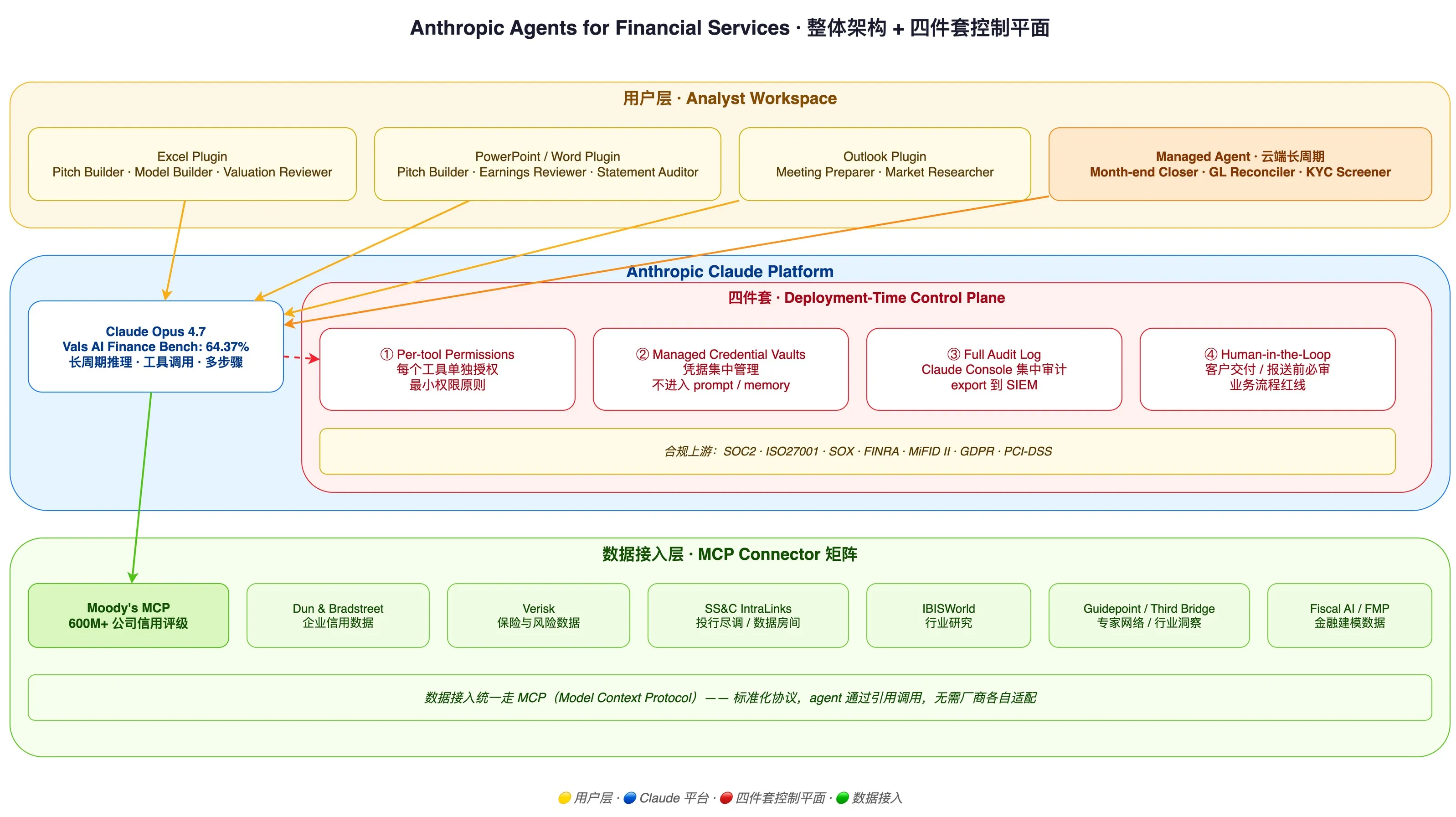
In May, Anthropic released Agents for Financial Services: 10 ready-to-deploy financial-services agent templates powered by Opus 4.7, covering end-to-end workflows from pitchbook generation to KYC screening to month-end close.
The real story here isn’t model performance—even though Opus 4.7 scored 64.37% on Vals AI’s Finance Agent benchmark, leading the industry. The real story is that Anthropic shipped four things as default configuration: per-tool permissions, managed credential vaults, full audit log in the Claude Console, and human-in-the-loop.
This is a very important signal. It shows that the security focus of frontier model vendors is shifting from “making the model more aligned” to “making agents actually deployable in regulated enterprise environments.” This article walks through the four pillars from an engineering perspective.
1. Why Agent Deployment Is Hard
Over the past two years, AI Agent demos have been everywhere—Claude Computer Use driving a desktop, Devin shipping entire projects, AutoGPT running tasks autonomously. But demos that actually enter critical enterprise workflows are vanishingly rare. The reason isn’t that the models aren’t smart enough; it’s that enterprise IT/security/compliance teams aren’t asking “can it run?”—they’re asking four other questions:
- What resources can it touch? (permissions)
- How does it obtain keys and credentials? (credential management)
- Can I inspect what it did? (audit)
- Are critical decisions reviewed by a human? (human approval)
If the answers to these four questions aren’t “complete, executable, and aligned with existing compliance frameworks,” the agent will not go live—no matter how smart it is.
Model alignment solves a different class of problem: “does the AI want to do bad things?” Constitutional AI, RLHF, red teaming—these techniques ensure the model doesn’t proactively cross lines without external intervention. But a model that doesn’t proactively misbehave is not the same as an agent that is safe inside an enterprise environment. You also need an entire deployment-time control plane—to ensure that even if the model tries to cross a line, it cannot break through the boundaries the enterprise has set.
Anthropic’s Finance Agents release happens to package “deployment-time control” into a visible product form for the first time.
2. Not New Models, Production-Ready Agent Templates
Let’s first lay out what was actually released.
The 10 templates split into two groups:
Research & Coverage (5)
- Pitch builder
- Meeting preparer
- Earnings reviewer
- Model builder
- Market researcher
Finance & Operations (5)
- Valuation reviewer
- General ledger reconciler
- Month-end closer
- Statement auditor
- KYC screener
Each template targets work that eats real analyst hours but follows a clear, rule-encodable process. The product selection logic is sharp: avoid the high-judgment core decisions (investment decisions, credit decisions themselves) and instead cover “preparing the materials and processes those decisions depend on.”
Two deployment shapes:
| Deployment mode | Runtime | Use case |
|---|---|---|
| Plugin mode | Embedded in Excel / PowerPoint / Word / Outlook | High-frequency, low-risk, analyst-in-the-loop |
| Managed Agent mode | Long-running sessions on the Claude Platform cloud | Multi-hour workflows, month-end close, overnight tasks |
Plugin mode lets the agent run on the analyst’s desktop, slotting cleanly into existing workflows. Managed Agent mode lets it run long autonomous tasks in the cloud—e.g. running an entire reconciliation cycle at month-end.
On performance: Opus 4.7 scored 64.37% on Vals AI’s Finance Agent benchmark—currently the industry lead. But we won’t dwell on performance here, because the point of this article lies elsewhere: the most fundamental differentiator of this release is “production-ready,” not “smarter.” The next sections walk through the four pillars.
3. Pillar One: Per-tool Permissions—Caging Tool Calls
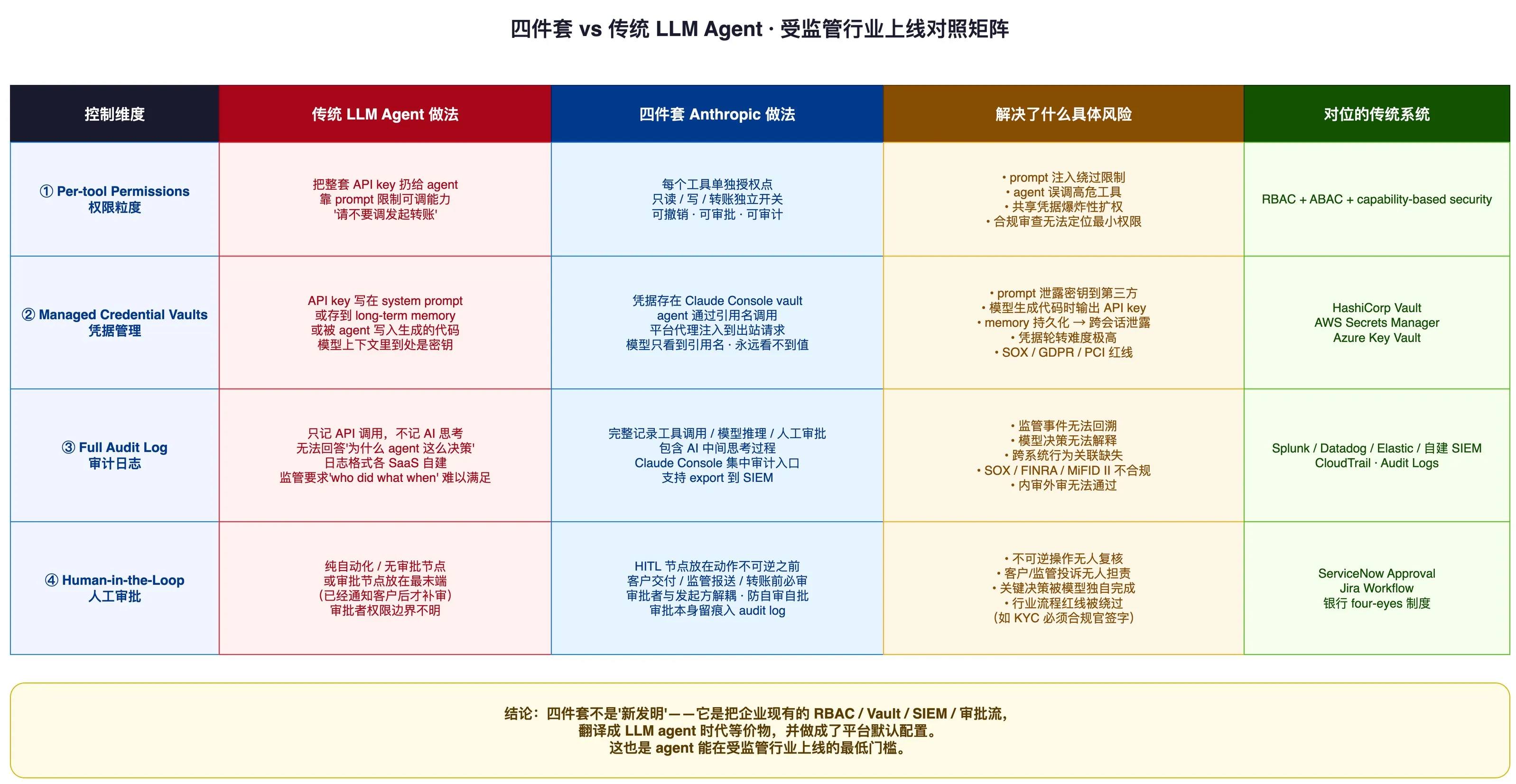
Per-tool permissions mean exactly what they sound like: every tool the agent can call requires its own permission grant, which can be toggled, approved, and audited independently.
How is this different from traditional RBAC? Traditional RBAC’s granularity is “user/role → API”—an analyst can call the ledger API, an auditor cannot. Per-tool permissions operate at “agent instance → tool → call context”—the same agent can call the “read account balance” tool but not the “initiate transfer” tool, even when both belong to the same underlying microservice in API terms.
Why is that granularity necessary? Because an agent’s capability boundary is not defined by APIs—it is defined by its tool set. Exposing the agent to “the account management API” means handing it every operation that API supports. But if you expose only read_account_balance as a tool, the agent simply does not have the “initiate transfer” capability—even if both ride on the same API underneath.
In financial scenarios this matters enormously:
Agent task: "produce a monthly statement analysis for the customer"

Required tools:
  ✓ read_account_transactions      # read-only transactions
  ✓ read_customer_profile          # read-only customer profile
  ✓ generate_pdf_report            # PDF generation
  ✗ initiate_transfer              # initiate transfer (not needed, disabled)
  ✗ modify_credit_limit            # modify credit limit (not needed, disabled)
  ✗ access_other_customers         # access other customers (not needed, disabled)
The agent-era equivalent of the principle of least privilege is per-tool permissions. By making this the default, Anthropic prevents developers from “lazily” handing every tool to the agent—you must explicitly declare permissions per tool. It looks tedious, but for regulated industries this is the minimum bar to clear a compliance review.
4. Pillar Two: Managed Credential Vaults—Credentials Never Leave the Enterprise Boundary
Managed credential vaults: API keys, database passwords, third-party service credentials—all centrally managed by the Claude Console. The agent calls them by reference, and they never enter the prompt, never enter the model context, and never appear in logs.
Why is this such a big deal? Because traditional LLM agents have three “misbehavior” patterns when handling credentials:
- Stuffing secrets into the prompt: developers shortcut by writing API keys directly into the system prompt—and then keys are scattered through the model context.
- Storing secrets in memory: in long sessions, the agent stashes credentials in memory “for next time”—if memory is persisted or borrowed by another agent, the secret leaks.
- Emitting secrets at code-generation time: when the agent writes a Python script to hit some API, the model may copy a “sample key” it saw during training verbatim into the code.
In regulated industries, any of these failure modes cuts straight through the SOX / GDPR / regulatory penalty red lines.
The vault design closes the door:
| Step | Traditional pattern | Vault pattern |
|---|---|---|
| Credential storage | In config files, prompts, code | In the Claude Console vault |
| Credential use | Concatenated directly into requests | Agent calls by reference name; platform proxy injects |
| Credential visibility | Model sees the raw value | Model only sees the reference name—never the value |
| Credential rotation | Edit code, redeploy | Rotate once in the vault—every agent picks it up immediately |
This is the same idea as HashiCorp Vault, AWS Secrets Manager, or Azure Key Vault, but in the LLM agent context the stakes are higher—because LLM agents are “more likely to want to look at the value” than traditional services (a bias inherited from training-data patterns). Stripping credentials out of the model context is one of the prerequisites for an agent to be deployable in production.
5. Pillar Three: Full Audit Log—The Minimum Bar for Regulators
Full audit log in the Claude Console: every tool call, every model inference decision, every human approval—logged into the Claude Console, available to compliance teams.
Why is this the “minimum bar” for regulated industries? Because the first requirement of every financial regulatory framework is “who did what when”:
- SOX: financial operations must be traceable to a specific accountable person.
- FINRA: all client-facing communication inside an investment bank must be auditable.
- MiFID II: EU financial services require a complete decision-chain trail for algorithmic trading.
- GDPR: processing of personal data must be explainable and auditable.
- PCI-DSS: every operation involving payment-card data must leave a trace.
The essence of these requirements is: when something goes wrong, the regulator must be able to obtain a complete log of “who did what when.” Before AI agents, this was relatively easy—the log read “Analyst A called the ledger API at 14:32.” But when an agent enters the picture, things get more complex:
- The originator of an action might be “Analyst A invoking the ledger API via Agent X.”
- Before that action, Agent X may have called the model 5 times, consumed 12,000 tokens, and considered 3 alternative plans.
- There may also be a human-approval node in between, with Analyst B as the approver.
A complete audit log in the AI agent era must record more than tool calls—it must also record the AI’s intermediate reasoning: which prompt triggered which inference, what the inference produced, why it chose this tool over that one. Whether the Claude Console’s audit log can capture this layer determines whether it can enter regulated enterprises at all.
In practice, enterprises will not consume logs only inside the Claude Console—they must export logs to their existing SIEM systems: Splunk, Datadog, Elastic, in-house audit warehouses. The technical integration here (webhooks / API pull / streaming push) is a key part of landing this in production.
6. Pillar Four: Human-in-the-Loop—Business Process Red Lines
Human-in-the-loop (HITL): before client delivery, regulatory filing, or any irreversible action, a human approval node is required.
Note the phrase “business process red lines”—not “safety guardrails.” The distinction matters:
- Safety guardrails are defensive: if the agent errs or is attacked, a human can intervene.
- Business process red lines are by-design: even when the agent performs perfectly, critical steps must involve a human.
Both matter in regulated industries, but HITL’s true position is the latter. Take KYC screening: even if the agent is 100% accurate, the final decision to open an account for a customer must be signed off by a compliance officer. That isn’t an AI problem—it’s an industry-process red line.
The HITL engineering design has several critical decision points:
| Decision point | Key question |
|---|---|
| When to insert | Immediately before the irreversible step (the most important rule) |
| Who approves | Role-bound, least privilege, separated from the agent’s caller (no self-approval) |
| What is the SLA | Approval timeouts differ for urgent vs. routine tasks |
| Approver authority | Can approvers edit the agent’s draft, or only approve/reject? |
| Approval trail | The approval itself goes into the audit log, including reasoning |
Anthropic emphasized this explicitly in the Finance Agents release: “users review and approve Claude’s work before client delivery or filing”—human review is required before client delivery or regulatory filing. That “before” is the key timing point: the HITL node cannot live at the very end (approving an irreversible action after the fact is meaningless); it must come before the action becomes irreversible.
A concrete example: the KYC screening + account opening flow
1. agent collects customer information       ← can be automated
2. agent runs AML screening                  ← can be automated
3. agent runs sanctions-list matching        ← can be automated
4. agent drafts a risk-assessment report     ← can be automated
5. ★ HITL: compliance officer approves ★     ← must be human
6. system creates the customer account       ← irreversible, must follow step 5
7. notify customer of account opening        ← customer-visible, must follow step 5
The HITL node sits at step 5—before the action is dispatched to downstream systems. That is a complete “business process red line.”
7. Ecosystem: The Connector Matrix and the Moody’s MCP Signal
The four pillars are the skeleton, but the agent only actually runs once we know which data sources it can reach. Anthropic announced a batch of data connectors at the same time:
- Dun & Bradstreet (corporate credit data)
- Fiscal AI (financial intelligence)
- Financial Modeling Prep (financial modeling data)
- Guidepoint (expert networks)
- IBISWorld (industry research)
- SS&C IntraLinks (investment-banking due diligence and data rooms)
- Third Bridge (industry insights)
- Verisk (insurance and risk data)
The most notable of all is Moody’s MCP app—built on the Model Context Protocol standard, exposing credit ratings on 600M+ companies to Claude agents.
The signal value here goes far beyond the data itself:
- MCP is becoming the de facto standard for financial-data integration: when an industry giant like Moody’s is willing to build on MCP, the standard has crossed the chasm.
- Data vendors are now actively integrating with AI agents: in the past, data vendors waited for SaaS integrations; today they ship MCP directly.
- Anthropic isn’t relying on first-party data ingestion—it’s relying on the ecosystem: a smart strategic choice—cede data integration to the vendors and focus on the agent platform plus the four-pillar control plane.
For enterprise buyers, the first filter when evaluating a financial AI agent shifts from “how smart is the model?” to “can it reach the data sources I use, and does it have the four pillars in place?” Anthropic’s release answers both questions at once.
8. The Real Shift: From Model Alignment to Deployment-Time Control
Step back and look at the broader trajectory.
For the past 2–3 years, frontier model vendors have framed safety like this:
- Constitutional AI (Anthropic)
- RLHF (OpenAI / Anthropic / DeepMind)
- Red teaming (industry practice)
- Refusal training (declining harmful requests)
- Many-shot jailbreak defenses
- Sandbagging detection
These all belong to training-time safety—shaping the model’s behavioral tendencies during training. They address the core question: “does the model itself want to do bad things?”
But the safety story in this Finance Agents release is a different set:
- Per-tool permissions
- Managed credential vaults
- Full audit log
- Human-in-the-loop
These all belong to deployment-time control—constraining the agent’s behavior boundaries at deploy time. They address the core question: “does the agent have boundaries that make it compliant and deployable inside an enterprise environment?”
This is a very important shift. It tells us:
- Model alignment is now necessary but not sufficient: alignment alone cannot get an agent into regulated industries.
- The real ceiling on AI commercialization is set by deployment-time control: because the big-ticket customers—large enterprises, banks, insurers, healthcare, government—are all under regulatory constraint.
- Other vendors will follow within a year: OpenAI’s Operator, Google’s Gemini Agents, AWS Bedrock Agents—if they want to enter regulated industries, the four pillars are an unavoidable minimum bar.
For AI safety practitioners, when evaluating an AI agent product, the next step shouldn’t be only “how strong are its jailbreak defenses?” but also “are the four pillars in place?” Model alignment and deployment-time control are two independent but mutually required lines of defense.
9. Closing: 5 Practical Recommendations for Enterprises
If you’re on an enterprise IT/security/compliance team currently evaluating or rolling out AI agents, here are 5 recommendations you can take directly:
-
Treat per-tool permissions as an extension of RBAC. Don’t try to constrain agent capabilities through prompts—prompts can be bypassed, injected, or forgotten. Put the permission boundary at the tool layer, with a separate switch per tool.
-
Credentials never enter the prompt. Not in the system prompt, not in memory, not in tool descriptions. All of it goes through a vault, and the agent calls by reference name. This is a hard requirement for going to production, not a nice-to-have.
-
Audit logs must connect to your SIEM. Don’t let logs sit only in the Claude Console. Pipe them into your existing Splunk / Datadog / Elastic / in-house audit warehouse, and correlate with logs from other systems—agent behavioral anomalies often only become visible when correlated against other system events.
-
HITL nodes must not sit at the very end. Place them before the irreversible step. Client delivery, regulatory filing, transfers, account opening—once these go out, you cannot pull them back. HITL must come before them.
-
Bring compliance into the conversation early. Document the concrete implementations of per-tool permissions / vault / audit / HITL in your compliance review materials and align with internal audit / legal / external auditors before the agent goes live—not after. The most expensive thing in regulated industries is discovering a compliance gap after launch.
Back to the opening thesis: model alignment will always matter, but it answers the question “does the AI want to do bad things?” When AI agents actually enter critical enterprise workflows, what determines whether they go live is a different set of questions—does it have permission boundaries, how are credentials managed, how is its behavior recorded, and who reviews its critical decisions?
Anthropic has drawn an engineering safety baseline for the entire industry. The job ahead for other vendors and enterprises is to make this baseline their own default configuration.
References: Anthropic - Agents for Financial Services, Vals AI Finance Agent Benchmark, Model Context Protocol specification, industry compliance frameworks (SOX / FINRA / MiFID II / GDPR / PCI-DSS).
Comments